My account Articles
RU EN
Database review · NLHE cash · off the table

Poker database review: where the money goes and how much

Upload your hand history to your account — your decisions are checked against the solver and the top regs, and the report shows which of them cost money, how much in bb/100 and what to work on first. The code does the math, an AI model explains it. Where the sample is too small, the report says so.

  • the express is free in the bot, a subscription from $89 a month
  • the subscription: a full review and a pool review every month, a personal account with the solver
  • a review within 60 minutes of payment; in English or Russian
Soon a strategy re-solved for your pool ↓
PokerStarsGGPokerWinamaxWPNiPokerChicopartypoker888pokerHand2Note
you lose vs the best play · river NL200 Zoom regular · 225,594 hands

Too few river check-raises from the BB

responding like the top regs — over the database +1,300bb · ≈ $2,600
509times in the BB in a single-raised pot vs CO/BTN the player checked the river and faced a bet
3.7%check-raises vs 10.7% for the top regs and 10.7% for the solver
+1.67bb from the moment of the bet vs +4.23 for the top regs — the gap is proven
response to a river bet: player / top regs
fold 66.6% / 62.6%
call 29.7% / 26.6%
check-raise 3.7% / 10.7%
solver: check-raise 10.7% — on the 274 of 509 hands that fit its tree; the player has 3.6% in them
In money this spot is played on par with the top regs, and still there is a decision inside it that costs money. EV is counted from the opponent’s bet: a fold is worth 0, a call or check-raise is what it won on top of what was already in. The comparison is with 2,395 of the same situations from the top regs; the solver check uses the player’s own hands, each at its point in the tree.
Who it is for

One calculation — three different reviews

The numbers are computed by code, the same way for any database. So the report works as a coach’s tool, as a regular’s review of his own game, and as a fund’s independent look at a player.

Poker schools and coaches

Review a student’s database before the session, so the hour goes to what matters instead of searching.

  • Mistakes are already sorted by money, within their own unit: bb/100 separately, points separately
  • Every student gets the same report structure — databases compare section by section
  • Run the student’s next database through the same report and compare: you see whether the fix reached the game
  • The free express to show a student what their leaks cost, the full review for students you work with closely
Regulars

Find where the money goes when the database is large and the winrate is flat.

  • Postflop checked against the solver on every flop type — 177 flops per spot, with its own tree for every pair of positions
  • Preflop checked against the solver in every spot, with the pool’s response in each
  • The price of every finding in bb/100 and the number of decisions it is based on
  • Postflop compared with the frequencies and winrates of six top regulars
  • Separately — what already works and should not be broken

Funds and backers

Assess a player independently from his own database, without his own commentary.

  • Winrate with a confidence interval — you see whether it is proven at all
  • Significance threshold |z| ≥ 2.6: random deviation is not called a mistake
  • The same review scheme for every player in the fund
What happens to your database

Five steps from archive to document

Only code calculates. An AI model writes the text on top of numbers that are already computed, and a second pass tries to refute every conclusion.

  1. 1

    Intake

    A folder, files or a zip, including zip inside zip. The room is detected per hand; a mixed Hand2Note export is split by room. Any file encoding.

  2. 2

    Verification

    Every hand is checked chip by chip against the room’s own summary. What cannot be parsed exactly — run-it-twice, a dead small blind, a truncated hand — is rejected explicitly and counted, not calculated wrongly.

  3. 3

    Calculation

    Checks against the solver and the top regs, stats with denominators, the price of decisions in bb, folds for every bet size, flop textures, the pool review.

  4. 4

    Text

    The model sees only conclusions and short examples without nicknames. Every number in its text is looked up in the calculation; if it isn’t there, the block is removed.

  5. 5

    Report

    A web page that opens in a browser and on a phone, with a table of contents, dark theme and full hand replays. The order of sections is set by code, not by the model. Reports come in English or Russian, your choice.

What you get

A free express and a subscription

The express is free in the bot — to see what your mistakes cost. The subscription is a full review and a pool review every month plus a personal account: the solver on your own hands, and whether your leaks are leaving your game.

What the bot sends: the free one-page express — how many of your leaks have a price and the three most expensive — and a sample full report on someone else’s database with the numbers blurred. One minute, no sound, a real calculation, nickname removed. Open the video on its own page, get yours in the bot.

Express

Free, in the Telegram bot
  1. How many of your leaks have a price — the price of each in bb per database and in bb/100
  2. Your three costliest leaks, also in money at your stakes, and where your game differs most from the solver
  3. A sample full report on someone else's database — how it is built, numbers blurred

Full review

In the subscription — every month, on your new hands
  1. Preflop against the solver and by hand category
  2. Winrate by position, stats, aggression, where hands end
  3. Top 5 spots; on every street — your game, then the pool against you
  4. The biggest mistakes, recommendations, takeaway
  5. Pool review: pool map, stats, folds by bet size and spot, exploits

Personal account

In the subscription — sign in with Telegram or by email
  1. Solver preflop and flop on your own hands: move by move, with the price of every action
  2. Play like solver — your line from the flop to showdown against the solver’s line, both against the regs from your own database; only what is proven (the whole interval below zero)
  3. Progress on every leak: do you repeat the mistake in the new review
  4. All reviews by month, reports as files
  5. Ordering and paying for the next review
The full review arrives in your personal account: the interactive version stays open for 30 days — until next month’s review, the standard report is an HTML file that never expires. The interactive version is one page: the preflop price of every hand in bb, your hands with that holding move by move against the solver, the solver’s preflop grid next to “My hands”, the solver flop strategy with the price of every action and the “Pool” tab — how the pool responds to bets and to steals. One minute, no sound, a sample on a real database, nickname removed. Open the video on its own page, subscribe.
The personal account: whether you repeat the same leak from review to review, where the solver plays better than you (Play like solver — both lines against the regs at your tables, from your own database) and where you already exploit the pool — those spots are worth keeping. One minute, no sound, a real database, nickname removed. Open the video on its own page, sign in.
Soon · a separate product

Next step — a strategy re-solved for your pool

The pool review shows where opponents go wrong. The next product answers how to take that money: a solver solution of the spot in which the opponent plays the turn and river the way the pool plays in the hand database, and you find the best response starting from the flop.

One minute, no sound: a 3bet pot BB vs BTN, Q♠J♥9♥. The pool of NL200–NL5000 regs locked from its own hands, the BB exploit next to GTO against the same pool and checked on the other half of the database. Open on its own page.

What adjusting to the pool is worth

pilot · flop Q♠J♥2♥ · SRP, BTN vs BB · 100 bb · rake 5%, cap 1.38 bb · BTN EV in bb per hand that reaches the flop

GTO vs GTO3.04
GTO vs the pool3.04
50% exploit3.43
model maximum3.83

Playing GTO, the pool’s mistakes are worth nothing. Adjusting to them — up to +0.79 bb, half of it — +0.39 bb. The maximum is the model’s limit, not a recommendation; the working share is 25–50%.

How BTN’s game changesGTO50%maximum
flop cbet43%23%3%
turn bet after flop check-check32%58%74%
raise vs the BB’s 33% turn bet9%28%40%
river bet after the BB checks42%71%87%
The whole line, not one adjustmentThe flop is solved with the pool’s turn and river mistakes in mind. Frequencies and EV of every hand on every street and for every turn card.
Choose your exploit shareFrom GTO to the maximum: you see how far you are willing to move away from equilibrium and what you get for it.
Too little data — equilibriumSpots where the pool played too few hands stay at equilibrium. The strategy is not built on random deviations.

In progress: BTN vs BB in a single-raised pot, 100 bb, the first flops are already solved. An interactive example on three flops — on request via Telegram.

Why you can trust the numbers

A stat that deviates is not yet a mistake

A tracker will show you forty percentages. The review answers a different question: which of them cost money, how much, and how well that is proven.

mistake

Costs money; proven by the solver or by the price of the bet.

→ fix
losing

A hand category plays worse than a simple fold.

→ fix first
you lose vs the best play

Worse than the best action, but not a loss.

→ fix if cheap
symptom

The cause may lie elsewhere than where it shows.

→ separate first
opportunity

You leave money on the table rather than lose it.

→ expand
difference

You play differently from top regs — not a mistake until money says so.

→ player decides

Every percentage has a denominator

27% over three hands and over a thousand are different things. Every frequency shows its sample; where there are no hands or too few, it says so: “no sample”, “small sample”.

3bet 14.6% (67,731) fold to 3bet 49.7% (7,739) cbet R 54.5% (1,004)

Pool folds against the break-even threshold

The pool’s fold is compared not with the pool’s own average but with the break-even threshold of a bet of that size. Above the threshold the bluff profits by itself.

river, bet 45–55% pot pool folds 58.1% threshold 32.4% s/(1+s) margin +25.8 pts 540 bets

A partly verified price is a range

Where a point cannot be named honestly, a leak’s price is an interval, and leaks are sorted by its lower bound. The price of each leak in bb is named only after the cases behind it have been read by eye.

river folds with bluff-catchers lower bound 0.48 bb/100 upper bound 0.86 bb/100 sorting weight — the lower one
±4.02winrate interval, bb/100

On the same 225,594-hand database a winrate of 3.16 bb/100 cannot be told apart from zero — and the report says so, instead of inventing findings to justify the work. Here the game can only be judged by the price of decisions, and that is exactly what the review calculates.

Limits of the method

What the review does not do

How every part of the report is calculated — on the page “How LeakPrice counts”.

  • Postflop — against regularsPostflop decisions are judged in hands against regulars and players whose class is not yet determined. Play against recreational players will be a separate kind of review; 4bet pots are not judged postflop — the spot is too rare. Overall stats and winrate by position use all hands.
  • After the session onlyIt reviews hands already played. It does not connect to the table or the poker client and gives no hints during a session — upload the database once you have finished playing.
  • Cash No-Limit Hold’em onlyTournaments, SNGs, Omaha and limit games are skipped.
  • Not a solver replacementPostflop is checked against the solver only in the spots it has solved, preflop against the solver’s ranges. Where there is no solver calculation — against top regulars’ frequencies and winrates and against the bet’s break-even threshold.
  • The pool review covers the pool as a wholeThe standard report covers the pool as a whole. Profiles of individual players are available on request, separately.
  • A spot’s winrate needs large samplesPricing a postflop spot takes roughly a hundred times more hands than measuring a frequency. Where the sample is small, money shows a direction, not a price.
  • Hand histories are not sent to the AIThe model sees computed conclusions and a few example hands in compressed form — without nicknames or table names.
  • Only the player’s own handsWe review hands the customer played, or hands of a player who has agreed to it — a school’s student, a staking team’s player. We do not accept purchased databases or hands collected by observing other people’s tables. How the hand history was obtained — from the poker client, by a tracker or a converter — and whether the room’s rules allow it is for the player to check.
Pricing

A subscription priced by stake, not by hands

A larger database makes the review more accurate and costs us nothing extra, so volume does not affect the price. The price depends on the stake: the same 0.5 bb/100 finding is worth four times more to a player at NL200 than at NL50.

The stake is detected from the database itself; with several stakes the price follows the highest one. Club hands and databases where the stake can’t be detected — $119. The switch is for estimating the price in advance.

Express

What your leaks cost — in bb/100 and money — and the three most expensive of them.

Freein the Telegram bot

one per account, a database of 20,000+ hands, an archive up to 20 MB (zip, rar or 7z); you get your short express and a sample full report

Send your database to the bot →

Subscription

Where the money goes, how much, what to work on first — and whether your leaks are leaving your game month to month.

$149a month

every month — a full review on your new hands and a pool review

personal account: solver preflop and flop, Play like solver, progress on every leak

no auto-billing: the next month starts when you send a new database

Upload your database →

Schools and funds

Databases of students or staked players — each with its own report.

−10%from 10 players a month

Package terms below →

Payment — crypto in your personal account; rubles, hryvnias or WebMoney — via @leak_price.

Schools, coaches, funds

Ten databases a month instead of one

For a coach the review shows which of the student’s mistakes cost money and where to start, not just stats. For a fund — where a player is losing now and whether the game holds from quarter to quarter. One report per player, same format — a web page.

Schools and coaches

−10%on each student’s subscription
  • package from 10 students a month
  • per student a month: NL2–50 — $80.10, NL100–200 — $134.10, NL400+ — $224.10
  • the subscription is the same as a player’s: a full review and a pool review every month, the personal account
  • express reports for students — without the one-per-account limit

Funds and backers

−10%on each player’s subscription
  • package from 10 players
  • a review every month — the account shows whether the leaks are going away and the game holds

Discuss a package in Telegram Alexander, @Alx94SS. Tell us how many players and which stake, and we reply with terms.

Articles and videos

How to read your own database

Stats, winrates by position, spots and the price of mistakes. Written by an AI model following the method of Alexander «AlexeSsz», a cash-game regular who checks every article; the databases are reviewed by the LeakPrice analysis system.

Exploit or leak: how to check your deviation from the solver

Deviating from the solver against the pool is normal. The question is whether it makes money against your opponents. How we compare your line with the solver's line against the regs at your tables, what the Play like solver tab will show, and why the price there is an interval, not a promise.

Solver vs the pool: why locking one flop is not enough

Against a reg who bets the flop and the turn a lot, a flop-only lock says check-raise more. A two-street lock shows something else: call the flop and play the turn. An example of BTN vs BB on K♠7♥4♠ and three reasons why pool locks usually lie.

All-in EV and EV diff: when to trust them

The green line is below the yellow one, and it looks like you are simply running bad. What all-in EV actually counts, why it does not measure luck as a whole, and which conclusions you can draw from it and which you cannot.

Flop cbet: why "the 60% norm" means nothing

Cbet frequency by itself does not say whether you lose money. What actually determines the right frequency, what an expensive cbet mistake looks like, and what to look at in the database instead of the overall percentage.

How to export your hand history for a review: PokerStars, GGPoker, Hand2Note, HM3, PT4

Where each room keeps its hand history files, how to export your whole database from a tracker as one archive, and what to check before sending so the review does not stumble on step one.

Rake at NL10–NL100: how much it takes and what to do about it

At micro stakes rake eats more than any mistake in play. How many bb/100 go to rake at different stakes, why a player in the plus before rake ends up in the minus after it, and which decisions actually change that.

All articles and videos

Start with one database

Upload an export for any period as one archive in your personal account. Room, stake and format are detected automatically; if the sample is not enough for conclusions, the report will say so. A mixed database works too: several rooms and nicknames of one player, exports through a converter.

Upload your database Sign in with Telegram or by email, archives up to 300 MB. The free express — straight in the bot @leakprice_test_bot
Free express
Telegram bot: @leakprice_test_bot
Subscription and orders
personal account: leakprice.com/cabinet; questions — Telegram @leak_price
Questions and partnerships
Telegram: @Alx94SS
Technical questions
Telegram: @Tyhran_Ovsepian
Channel
pool analysis and news (in Russian) — @leakprice_poker
Price
the express is free in the bot, a subscription from $89 a month — all prices
Turnaround
the free express in the bot — usually 5–10 minutes, up to 30–45 minutes in a queue; a full review — up to 60 minutes after payment: the calculation runs on the server, an operator checks the conclusions and publishes the review in your account.
Format
web page: opens in a browser and on a phone; in English or Russian
Feedback

What players say after a review

The review is great. It showed me leaks I would never have found on my own, because I am simply not competent enough. It also highlighted the simple leaks I already knew about, and showed how much I lose because of them. Now I am fully motivated to fix all of it.

I like it — fully happy with the value for money. I've only gone through 20–30% so far. Of course it's not [a coach's manual review], but the price isn't $500+ either.

About the authoropen

Alexander «AlexeSsz»

Cash game regular. Previously played NL2000–NL5000, now PokerStars Zoom NL200. Known in the Russian-speaking poker community from the forum and streams.

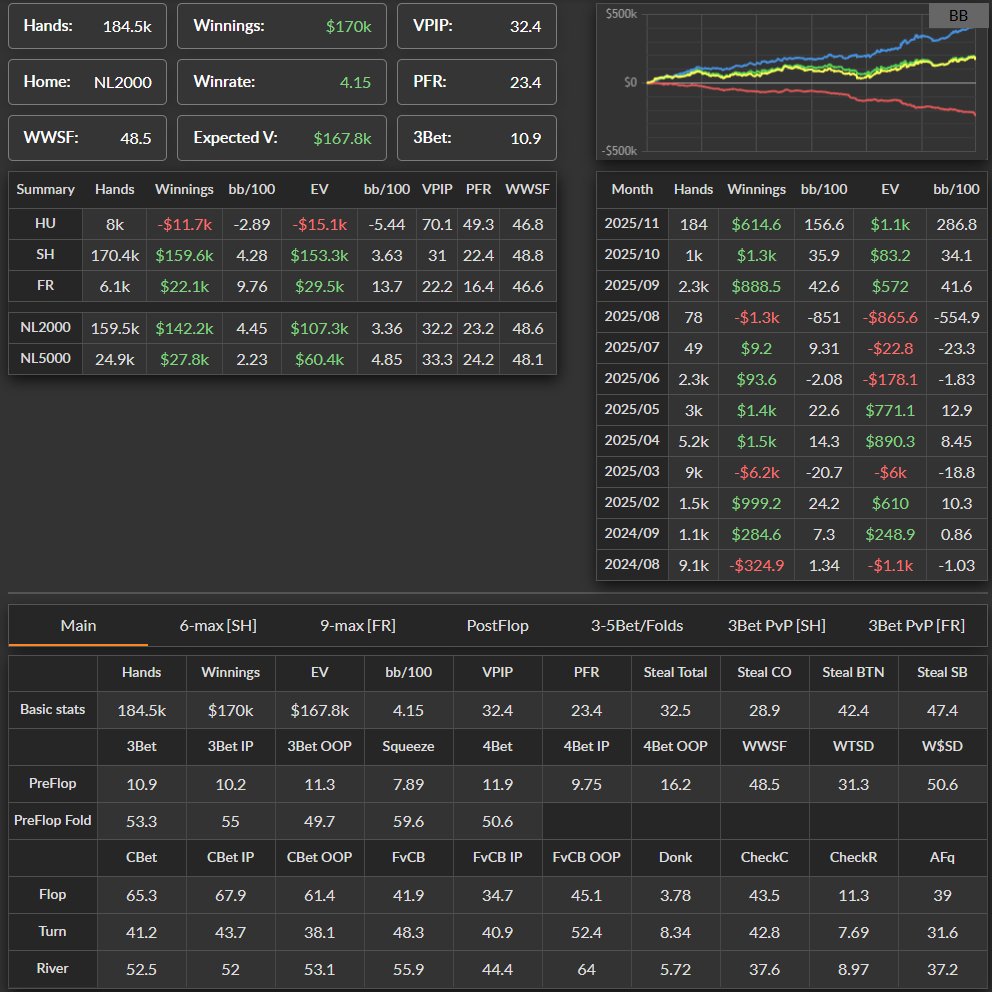
2022–2025 · NL2000–NL5000184.5k hands · +$170k · 4.15 bb/100 · SmartHand
SmartHand stats, 2022–2025
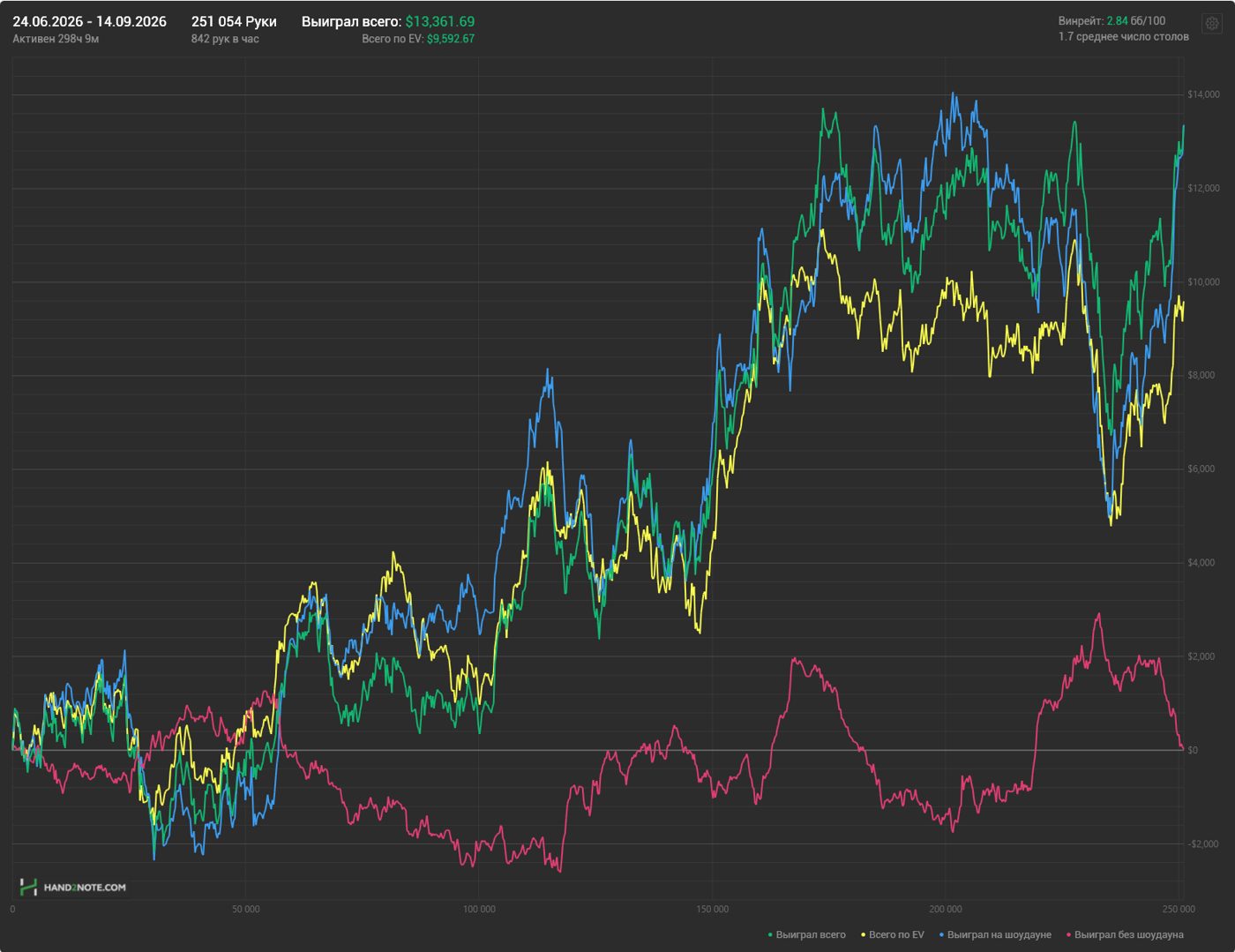
Now · PokerStars Zoom NL20024.06–14.09.2026 · 251,054 hands · +$13,362 · 2.84 bb/100 · Hand2Note
Hand2Note graph, Zoom NL200

Why I built LeakPrice

I have always loved reviewing my own database and comparing it with the databases of the best players. But the tools I used were not very convenient.

Now I get any situation on request: I can run a deep analysis of my database preflop and postflop and pull out any number I need. Find out at what time I play best and at which hours the tables have the most profitable line-ups.

Telegram: @Alx94SS